SN·MCMXIX
50.0833° N · 14.4135° E
Volume I · The Right Bank

Smetanovo nábřeží

A walk along the right bank of the Vltava,
where Prague learned to listen to its river.

An editorial in five movements & a coda Continue

“Vltava — the river that runs through every Czech.”

— a saying often attributed to Smetana, never traceable to him
I

Movement the First

The Embankment

andante.  Where Staré Město meets the water.

Where the Vltava bends beneath the spires of Staré Město, a stone promenade carries you for some four hundred metres through the music of Prague. Smetanovo nábřeží runs along the right bank of the river, between the great arches of Karlův most and the curve toward the Národní divadlo, gathering, in its modest length, more cultural weight than perhaps any other quarter-mile in Bohemia.

It is not a wide street, and it is not, in the way of European riversides, especially busy. Its trams pass; its joggers and its tourists pass; its anglers, in the warmer months, settle into the rail and pretend not to notice them. What endures is the angle of the light coming off the water at five in the afternoon, and the slow turn of the river toward Malá Strana, and the silhouette of the Castle that no Praguer ever quite stops looking at.

It is, in the literal sense, an edge — the moment at which the medieval city stops and the river begins — and like all edges it has the quality of being a stage. Smetana stands at the centre of it, in bronze, looking out at the water. The waterworks tower watches over his shoulder. The bridge spans away into Malá Strana. None of it is accidental.
Schematic map of Smetanovo nábřeží Stylised diagram of the right bank of the Vltava in Prague, showing the embankment between Charles Bridge and the National Theatre, with numbered landmarks. N MALÁ STRANA Vltava STARÉ MĚSTO KARLůV MOST Národní divadlo 1Water Tower 2Smetana Museum 3Smetana statue 4Novotného lávka 5Café Slavia 6Národní divadlo
Fig. 01 The right bank, with Karlův most at the north and the Národní divadlo curving to the south. Numbered points correspond to landmarks visited in Movement IV.
II

Movement the Second

From Františkovo
to Smetanovo

moderato.  A street learns its name twice.

Originally christened Františkovo nábřeží after Emperor Franz I, the embankment took on its present name in 1919, in the first months of Czechoslovak independence — a rededication that severed an imperial title and replaced it with a national soul. The composer who replaced the emperor had died thirty-five years earlier. The river, of course, took no notice.

The right-bank promenade had been engineered in the second half of the nineteenth century, when Prague — like Paris, like Vienna, like every European capital then in love with the idea of itself — was reordering its medieval frontages into something the bourgeoisie could stroll along on a Sunday. Old buildings were lost; new vistas were gained. The Old Town, which for centuries had backed away from the river behind walls and waterworks, suddenly faced it.

For two generations the embankment carried Franz's name. Then, in the autumn of 1918, the Habsburg empire dissolved, and within months Prague's city council had handed over its honorary streets to a different pantheon: composers, presidents, philologists, Hus. The waterworks tower kept watch through all of it.

  1. 1841 Construction of the right-bank promenade begins, on land reclaimed from the river.
  2. 1876 Officially named Františkovo nábřeží, in honour of Emperor Franz I.
  3. 1881 The Národní divadlo opens at the southern end of the quay.
  4. 1884 Death of Bedřich Smetana, deaf for the last decade of his life.
  5. 1919 In the new Czechoslovak republic, the embankment is renamed Smetanovo nábřeží.
  6. 1949 A waterside statue of Smetana is unveiled at Novotného lávka, facing the river.
  7. today Tram 17, the cafés, the anglers, and an unbroken view of the Castle.
III

Movement the Third

The Composer's Shore

vivace, ma non troppo.  Music written by a deaf man for a river he could not hear.

Bedřich Smetana — born 1824 in Litomyšl, died 1884 in Prague — lived deaf to the river he had immortalised. By the time he composed Vltava, the second of the six symphonic poems forming Má vlast, he could no longer hear the orchestra play it. What he heard was an idea of the river: a small spring high in the Šumava, a second stream joining it, a forest hunt on the banks, a peasant wedding under the trees, the white rapids of St. John, and at last — the river arriving, broad and sovereign, into Prague.

That arrival is what you stand on when you stand on this embankment. The melody — e d e g d e g b e — is the most quoted in Czech music. Every Czech schoolchild can hum it; every Czech wedding has, at some point, used it. It is, in a way that almost no other piece of orchestral music is, a national property.

Smetana never heard it performed. He premiered Má vlast in 1882, two years before his death, by following the score in his head. He died without recovering his hearing, in an asylum on the other side of the river. He was buried at Vyšehrad. His statue, on this quay, faces the water.

Fig. 02 Opening of the river-theme from Vltava. Composed in 1874 in nineteen days, by which time Smetana had been deaf for nearly a year.

The river arrives, broad and sovereign, into Prague — and the orchestra, at last, lets it speak.

IV

Movement the Fourth

Landmarks Along the Quay

allegretto.  Six fixed points and a thousand passing ones.

01

Old Town Water Tower

Staroměstská vodárenská věž

Built in the late 1480s as part of Prague's Renaissance waterworks, the tower pumped Vltava water uphill into Old Town fountains. Damaged by fire in 1885, restored, and now an unmistakable silhouette at the foot of Charles Bridge.

02

Bedřich Smetana Museum

Muzeum Bedřicha Smetany

Housed since 1936 in the neo-Renaissance former waterworks building beside the tower. Manuscripts, his hearing trumpet, the piano on which Má vlast took shape.

Open Wed–Mon · 10–17

03

Statue of Smetana

Pomník Bedřicha Smetany

Bronze, by Josef Malejovský, unveiled 1984 on the centenary of the composer's death. Smetana sits with score in hand, facing the water — back to the city he wrote for.

04

Novotného lávka

The Novotný Footbridge

A short pier extending into the river, hosting the museum, the statue, restaurants, and the only viewpoint from which Karlův most can be photographed in full broadside.

05

Café Slavia

Kavárna Slavia

Opened 1884 — the year Smetana died — at the southern end of the quay. The corner table by the window has, in its time, seated Rilke, Seifert, Hrabal, Havel. The view, from that table, is of the Castle.

Open Daily · 08–24

06

Národní divadlo

National Theatre

Not on the embankment proper, but anchoring its southern end. Opened in 1881 with Smetana's Libuše; burnt within weeks; rebuilt by national subscription and reopened in 1883 with the same opera.

V

Movement the Fifth

The View From the Railing

largo.  What you see, when you finally stop walking.

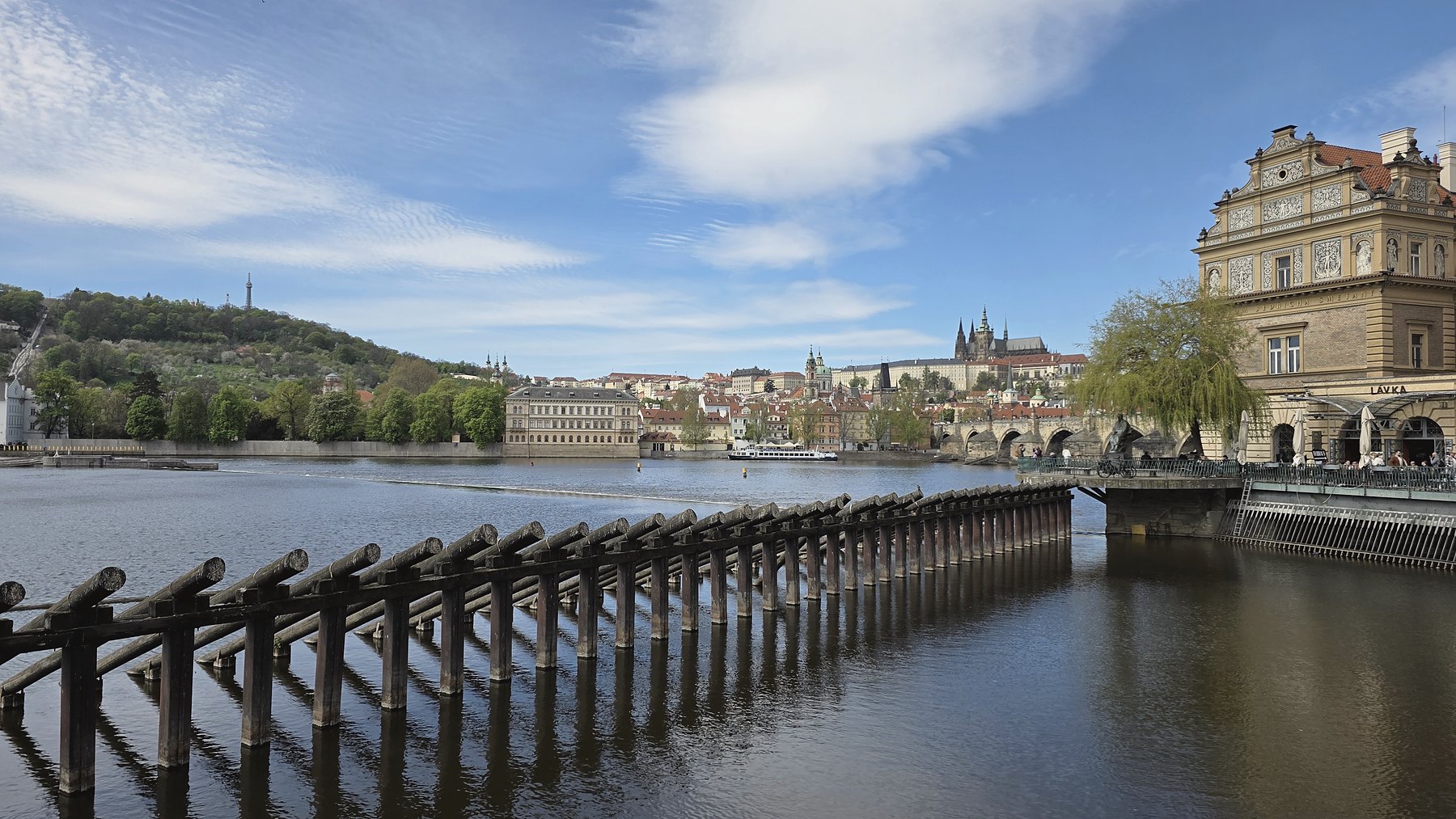
View north from Smetanovo nábřeží: wooden ice-breakers in the foreground, Karlův most spanning to Malá Strana, Pražský hrad and the spires of St. Vitus rising on the right, the corner of the Bedřich Smetana Museum at the far right.
Fig. 03 Looking north from the railing: the wooden ice-breakers, Karlův most spanning to Malá Strana, Pražský hrad above, and the corner of the Bedřich Smetana Museum on the right.

Stand at the railing on a clear evening. To the north: the soot-darkened ribs of Karlův most, the small flotilla of swans, the red roofs of Malá Strana climbing toward Pražský hrad. To the south: the gilded cap of the Národní divadlo. Behind you: the cafés and the small museum where Smetana, in bronze, faces the river he could not hear.

Above all of it, sometimes, a single melody — taught, hummed, half-remembered — passing through whoever crosses the bridge. The Vltava goes on, the way rivers do, to Mělník and to the Elbe and to the North Sea. The embankment, with its bench and its tower and its statue, stays where it was put.

  • N
    Karlův most + Malá Strana, Pražský hrad on the rise above
  • W
    Vltava flowing seaward; swans, kayaks, paddle-boats in summer
  • S
    Národní divadlo gilded roof catching the last sun
  • E
    Staré Město Café Slavia, then the alleys back into the city

Encore

Within Walking Distance

A few more excursions, all reached from the railing in five minutes or less.

Pražské Benátky

Prague Venice — historic boat tours

Forty-minute rides on faithful replicas of historical Prague riverboats, through the Čertovka canal and around Kampa. The operator's pier sits at the foot of Charles Bridge, two minutes north of the railing.

prazskebenatky.cz

Muzeum Karlova mostu

Charles Bridge Museum

A small private museum at Křižovnické náměstí, devoted to the medieval construction of the bridge, its saints, and the centuries of floods it has survived.

muzeumkarlovamostu.cz

Šlapadla na Vltavě

Pedal boats on the Vltava

Several rental stalls along Slovanský ostrov hire pedal boats and rowboats by the half-hour. The river is calm here; from the water, every landmark in this guide reverses itself.

Atmosphere

An informal pub

Czech beer and no pretension, a few minutes inland from the southern end of the quay. The corner where the cafés stop being serious.

atmoska.cz

Coda

How to Visit

Practical notes for the wanderer.

Getting there

Tram 17 stops at Karlovy lázně at the northern end. Or alight at Národní divadlo from trams 2, 9, 17, 18, 22, 23 and walk north along the rail.

Best hour

Late afternoon, an hour before sunset — the Castle takes the light first; the river last. In autumn the light lasts longer than you expect.

Cost

The embankment, naturally, is free. The Smetana Museum charges a modest entry. The cafés charge what cafés in Old Town charge.

Take with you

The opening of Vltava in your pocket, on whichever device you carry music on. Begin it as you reach the rail. Forty minutes will pass.